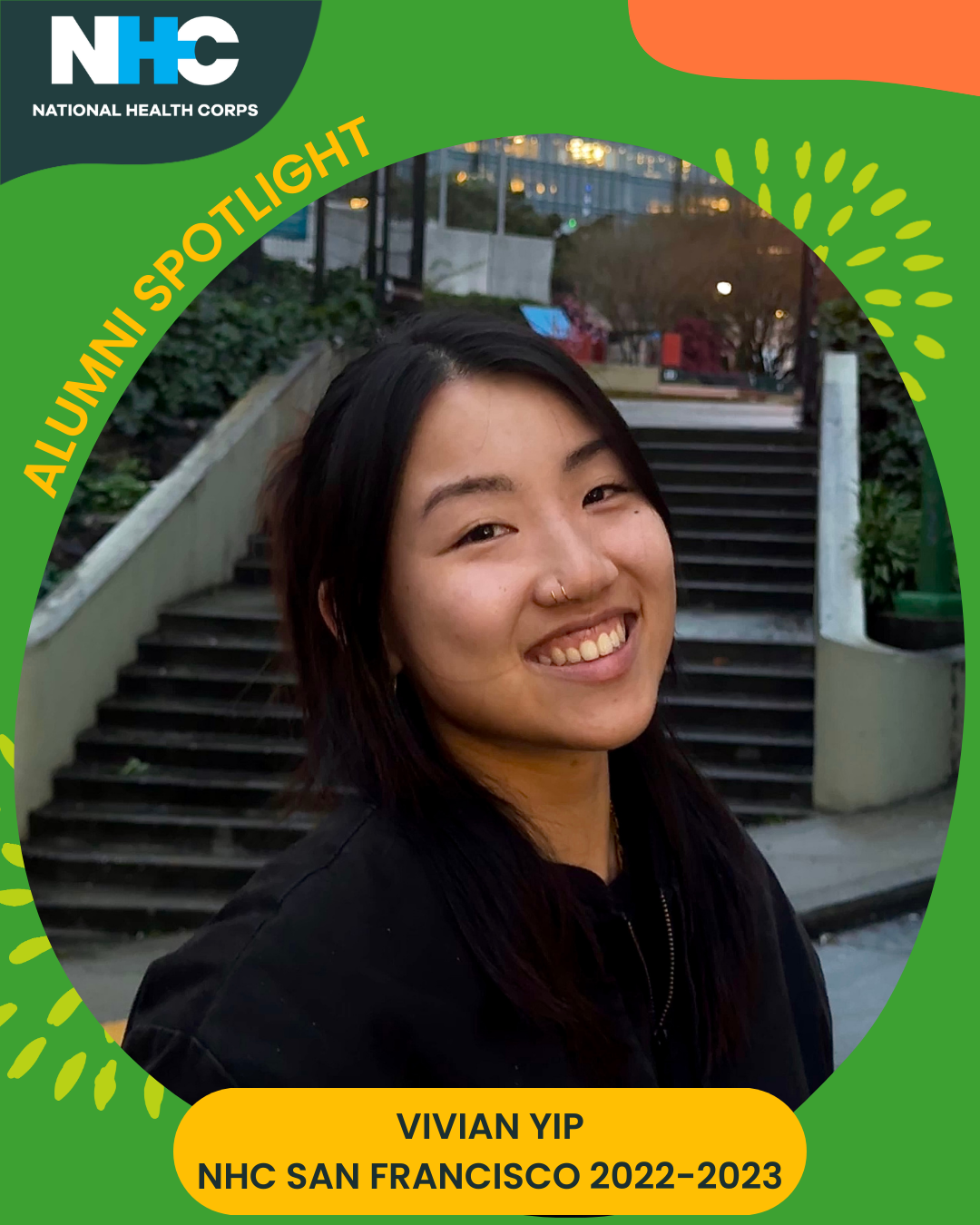
Alumni Spotlight: Meet Vivian Yip, NHC SF 2022-2023 Alumna!
Brandon Phommasack is a 2024–2025 National Health Corps member with NHC San Francisco, serving at HealthRIGHT 360 as an Opioid Care Coordinator and supporting Street and Mobile Medicine initiatives. His work centers on medication-assisted treatment (MAT), care coordination, and connecting San Franciscans to medical and social services across healthcare systems.
As part of NHC San Francisco’s Alumni Spotlight series, Brandon connected with Vivian to reflect on the meaning of accompaniment in care work, navigating complex healthcare systems, and continuing to grow within the community she served. As a 2022-2023 AmeriCorps member, Vivian Yip began her service term with the San Francisco Department of Public Health’s Whole Person Integrated Care Program in the middle of the program year (2023-2024) and supported both the Street Medicine Palliative Care and Post-Overdose Engagement teams while connecting across two NHC San Francisco cohorts.
Read on to learn how Vivian’s AmeriCorps experience continues to shape her approach to healing and community-based care.
__________________________________________________________________________
Brandon: Can you share your role during your AmeriCorps service and when you served?
Vivian: I served from 2023 to 2024 with the San Francisco Department of Public Health under the Whole Person Integrated Care program. During my term, I worked with both the Street Medicine Palliative Care Team and the Post-Overdose Engagement Team. I joined midway through one cohort and stayed through the next, so I had the chance to experience two different cohorts and learn from people coming into the work with different perspectives and energies.
Brandon: Abridged! Common ground already. When did the work start to feel meaningful for you?
Vivian: There was a learning curve in figuring out what my role was and how I fit into the team. It felt a bit like a “create your own adventure” at first, where I was meeting different teams and learning how things worked as I went.
About halfway through my term, once I started building consistent relationships with clients I was seeing week after week, the work really started to feel meaningful. Especially in palliative care, it felt special to be able to accompany people through their lives as they were living and sometimes dying. To hear their stories, priceless.
Brandon: What did a good day of service look like, and were there moments that really stayed with you?
Vivian: A good day often felt very simple and very human. A lot of the work was relational, meeting people where they were, going on walks, getting coffee, and listening to their stories. Especially in palliative care, it sometimes felt like I was just hanging out with someone and getting to know them for who they were at that moment.
There are so many moments that stayed with me, but one that stands out was accompanying someone to their first oncology appointment. I met them at the shelter they were staying at, we took the bus together, and on the walk to the hospital we picked flowers along the way. It turned into a several-hour journey where I got to hear their stories and just be with them, and it felt really special to be invited into such an intimate part of their life.
Brandon: Flower picking in the city, I can imagine the scene, Memorable. How did this work shape how you understood care and healthcare systems in real time?
Vivian: Working in street medicine and palliative care showed me how much care depends on coordination and communication across teams, providers, and systems that don’t always talk to each other.
It also shifted how I think about care more broadly. I learned that care isn’t always about having answers or fixing things quickly, but about showing up consistently, building trust, and being okay with uncertainty while navigating complex systems alongside people.
Brandon: What does your work look like now, and what skills from your AmeriCorps service do you still use?
Vivian: I’m currently a health worker with the San Francisco Department of Public Health Whole Person Integrated Care program on the Shelter Health Team, which is actually the same host site I was at during my AmeriCorps term, just on a different team now. The Shelter Health Team covers over 20 shelter sites across San Francisco, staffing drop-in clinics at each site with a nurse, health worker, and provider. We offer free on-site wound care, STI testing, urgent care support, over-the-counter medications, and connections to primary care and other medical services.
While guests are staying in shelter, we also do a lot of care coordination, supporting communication across different care teams and helping with discharge planning if someone is hospitalized. Our visits can range anywhere from a few minutes to over an hour, which feels really meaningful because we’re able to offer spaciousness for whatever people want to talk about and time to brainstorm options together if that’s where they’re at. Sometimes it’s also just sitting together and holding difficult feelings like grief or pain. Maybe we can’t change or fix anything in that moment, but we can hold that space together.
Alongside Shelter Health, I also still work with the Street Medicine Palliative Care Team as a health worker and support their Enhanced Care Management program. I was on this team during my AmeriCorps service, so it’s a familiar role. We provide palliative care to people living outside and support the complex coordination that comes with navigating serious or terminal diagnoses while being unstably housed and receiving care across multiple systems. A big part of this work is accompanying people as they move through life and death, and holding space for their stories, grief, life review, and legacies.
Brandon: What piqued your interest in returning to DPH after your AmeriCorps term?
Vivian: I learned a lot during my AmeriCorps term at DPH things like care coordination, listening, practicing curiosity, building relationships, and navigating care systems and as my term was ending, I felt like there was still more to learn from the teams and clients I had met. Continuing with DPH WPIC felt aligned with how I wanted to grow at that moment.
I had also built ongoing relationships with a few palliative care clients whom I was seeing every week, so being able to continue visiting them when I returned to DPH felt really meaningful. With the length of an AmeriCorps term, you often come into this work, build relationships, and then leave within less than a year, so it felt really special to have the chance to continue those relationships and create more continuity.
It was also the first time I had worked on a team practicing a street medicine and harm reduction model of care, and I wanted to keep learning. The flexibility we had for longer visits, collaboration, and creative problem-solving felt very different from other healthcare environments I’d experienced.
Brandon: As you look ahead, what do you hope to do next?
Vivian: I know that I want to continue doing healing and healthcare work, even though I’m not exactly sure what that path looks like yet. I do see myself continuing school in the future to train in both Western medicine and Chinese medicine. There are moments in my work and personal life where I wish I had more medical knowledge and exposure to different approaches to healing so I can better support community members.
I believe healthcare should be accessible to everyone and exist outside of systems that prioritize profit over care. In pursuing further training, I hope to gain more knowledge to share and to offer care in ways that aren’t tied to for-profit models. There’s also a lot of diversity in healing traditions across cultures, and I hope to learn more about the practices from my own ancestry and incorporate those approaches into my future work.
Brandon: Looking back, what advice would you give to new or incoming NHC members?
Vivian: I’d say be curious and give yourself permission not to have everything figured out right away. This work is deeply relational, and taking the time to build relationships with clients, colleagues, and community members really matters. Even when the work feels heavy or uncertain, those connections are what make the experience meaningful.
About the Author
